3adan | عدن — Home
3adan Fresh Kale logo

3adan · Fresh Whole Kale

Fresh from the Fields. Made for Your Table.

Discover fresh 3adan kale, its nutritional qualities, and delicious ways to bring it to your table.

The 250 g bag

Whole leaves, in plain sight

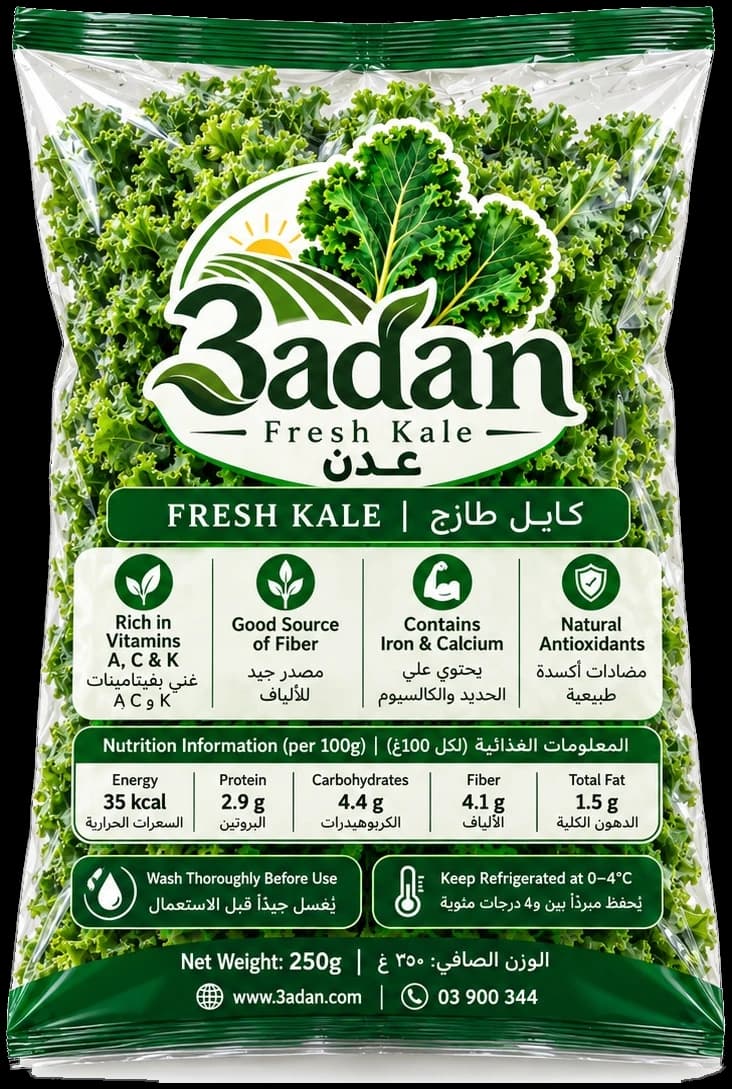
3adan Fresh Kale 250 g bag — front

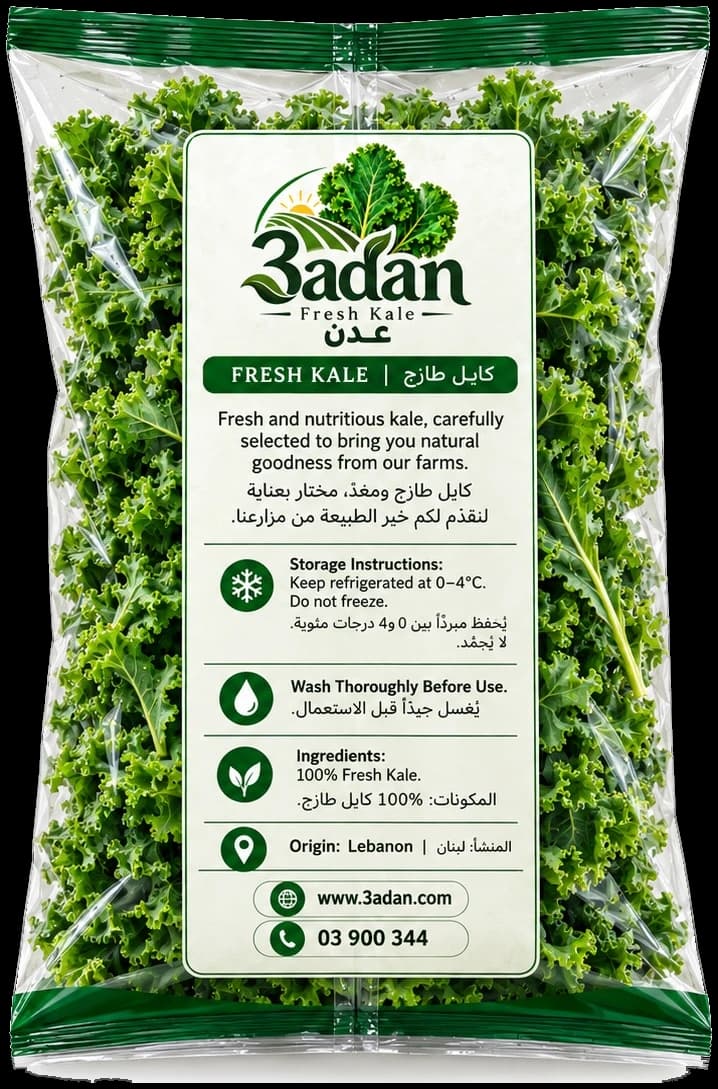
Fresh whole curly kale in a transparent green-and-white bag, 250 g net. Unwashed — wash it thoroughly before use, and keep it refrigerated at 0–4 °C.

Product details

About 3adan

3adan: a fresh new guest at the Lebanese table

3adan is a Lebanese brand dedicated to fresh kale. We offer whole curly kale leaves in a 250 g bag, for you to turn into a fresh salad, a warm cooked dish or a crisp snack.

Our aim is simple: to make kale easy and delicious for Lebanese tables. So here you’ll find step-by-step guides to washing and preparing it, and recipes that pair it with flavors we know and love — lemon, olive oil, bulgur, tahini and pomegranate molasses.

Our name echoes “Jannat 3adan”, the Arabic for the Garden of Eden — green land, abundance and food shared around the table. That’s what we hope every bag brings to your kitchen.

3adan Fresh Kale logo

جنة عدن

What is kale?

A leafy cousin of cabbage and broccoli

Kale is a leafy green from the cabbage family (Brassicaceae) — the same plant species as cabbage, cauliflower and broccoli. Unlike cabbage, it doesn’t form a head: its leaves grow around a central stem. Its flavor is earthy and slightly peppery, with a gentle bitter edge that lemon, olive oil and cooking soften.

Family
Brassicaceae (cruciferous)
Species
Brassica oleracea, like cabbage
In the 3adan bag
Curly kale
Eat it
Raw or cooked
Learn more about kale

Key nutrition

What’s in 100 g of raw kale?

Per 100 g, raw kale provides about 35 kcal. It’s rich in vitamin K and vitamin C, a source of calcium, and provides 4.1 g of dietary fiber.

Energy
35kcal
Protein
2.9g
Carbohydrates
4.4g
Dietary fiber
4.1g
Total fat
1.5g

These are general reference values for raw kale per 100 g from USDA FoodData Central — not a laboratory analysis of 3adan kale. Actual values vary with variety, season and storage.

Why include kale

Good reasons to bring kale to your table

  1. Rich in vitamins K and C

    Vitamin K contributes to normal blood clotting and the maintenance of normal bones; vitamin C contributes to normal immune function and helps the body absorb iron from plant foods.

  2. A source of calcium and fiber

    Calcium is needed for the maintenance of normal bones and teeth, and fiber is part of a balanced diet that contributes to normal digestion.

  3. Carotenoids in every leaf

    Kale contains beta-carotene, which the body converts to vitamin A, as well as lutein and zeaxanthin. Vitamin A contributes to the maintenance of normal vision.

  4. At home in Lebanese cooking

    From tabbouleh and fattoush to soups, omelettes and crispy chips, kale slips easily into everyday dishes — raw or cooked.

3adan Fresh Kale 250 g bag — front

Drag to turn the bag

Our product

Fresh Whole Kale — 250 g

Just one ingredient: fresh raw curly kale, whole leaves, in a transparent bag that shows you the leaves before you buy.

  • Net weight: 250 g
  • Fresh whole curly kale — ingredient: fresh raw kale
  • Unwashed — wash thoroughly before use
  • Keep refrigerated at 0–4 °C. Do not freeze.

Unwashed — Wash Thoroughly Before Use

Keep Refrigerated at 0–4°C. Do not freeze.

Fresh Whole Kale · 250 g

From field to bag

The journey of a kale leaf

Eight stops from the field to the bag to your kitchen. Steps that describe 3adan’s own process are marked as awaiting confirmation, and real photos are on their way.

  1. In the field

    Kale is a cool-season crop: it grows best in mild weather and tolerates light frost. Each plant grows its leaves around a central stem, without forming a head like cabbage.

  2. Healthy curly leaves

    Curly kale forms a rosette of ruffled leaves, bright to deep green. The outer leaves are the largest, while young leaves keep growing from the heart of the plant.

  3. Hand harvesting

    Kale is usually harvested by hand, leaf by leaf. The outer, lower leaves are picked first, and the young heart is left to keep growing for the next picking.

    Requires business verification
  4. Selecting and sorting

    After picking, the leaves are checked by eye. Yellowed, torn or wilted leaves are set aside, and the firm green leaves move on to weighing.

    Requires business verification
  5. Weighing 250 g

    The selected leaves are weighed into 250 g portions — the net weight printed on every bag.

    Requires business verification
  6. Packaging

    Each 250 g portion is packed in the transparent green-and-white 3adan bag, so you can see the leaves before you buy. The label carries the product name, the net weight and the ingredient: fresh raw kale.

    Requires business verification
  7. To vegetable stores

    The bags head out to vegetable stores and retail partners. The list of stores will be published on the “Where to find 3adan” page as each one is confirmed.

    Requires business verification
  8. In your kitchen

    At home, keep the bag in the fridge until you need it. Just before cooking, rinse the leaves under clean running water, dry them well and remove the thick stems — then massage them for a salad or cook them your way.

From our farm

Recipes

Everyday kale recipes

From kale tabbouleh and fattoush to soups, pesto pasta and crispy kale chips — easy recipes that make the most of every 250 g bag.

All recipes
Illustration

Salads

Lebanese Kale Tabbouleh

Tabbouleh is the queen of the Lebanese table, and here very finely chopped kale takes over part of the parsley, adding a gentle crunch and a soft, earthy note. The rules stay the same as ever: plenty of greens, just a little bulgur and a generous hand with the lemon.

30 minutesMediumRaw150 g

Illustration

Salads

Kale Fattoush

No Lebanese table feels complete without fattoush: crisp toasted bread, crunchy seasonal vegetables and a sumac and pomegranate-molasses dressing that is both tangy and gently sweet. Here massaged kale joins the bowl, adding a green crunch that holds up to the dressing far longer than lettuce.

37 minutesEasyRaw100 g
Illustration

Vegetarian / vegan

Garlic Lemon Sautéed Kale

Inspired by the way Lebanese grandmothers cook wild greens such as hindbeh (dandelion) with olive oil and garlic, this quick sauté turns a bag of kale into a bright, tender side dish finished with a squeeze of lemon. It is ready in under 20 minutes.

18 minutesEasyCooked250 g
Illustration

Healthy snacks

Crispy Oven-Baked Kale Chips

Crisp, lightly salted and gone in minutes. With just a little olive oil and a gentle oven, kale leaves turn into feather-light, paper-thin chips — a snack for all ages and a crunchy topping for soups and salads.

35 minutesEasyCooked100 g
Illustration

Soups

Kale & Lentil Soup

On cold days, few things warm you like a bowl of lentil soup. This one is inspired by Lebanese adas bi hamod — brown lentils, potato, garlic and coriander — with kale stirred in at the end so it stays green and tender, and a generous squeeze of lemon to finish.

65 minutesEasyCooked125 g
Illustration

Lebanese & Mediterranean

Kale & Halloumi Wrap

Golden grilled halloumi rolled up with lemony massaged kale, labneh, tomato, cucumber and fresh mint in warm Lebanese bread. It is a quick, satisfying lunch with the flavors of a Lebanese table, ready in about 20 minutes.

23 minutesEasyCooked75 g

Leaf explorer

What’s inside a kale leaf?

Tap the points on the leaf to discover the key nutrients in raw kale, each with a kitchen tip. Values are reference values per 100 g.

Tap the points on the leaf to discover what it contains.

Established

Fiber

4.1 gper 100 g, raw15% DV

Raw kale provides about 4.1 g of dietary fiber per 100 g. Fiber is an essential part of a balanced diet and contributes to normal digestive function.

In the kitchen

Don’t discard the stems — chop them finely and cook them into soups or stews.

Sources: U.S. Department of Agriculture · Harvard T.H. Chan School of Public Health — The Nutrition Source

A simplified educational visual — not a medical or diagnostic tool. Values are references for raw kale.

How to prepare

Four steps to great kale

  1. Wash

    Rinse the leaves under clean, cool running water just before using them, rubbing gently with your hands. Water alone is all you need.

  2. Dry

    Pat dry with a clean towel or spin in a salad spinner — dry leaves hold dressing better and crisp up in the oven.

  3. De-stem

    Strip the leaves off the thick stems, then chop or tear them. Keep the stems — chop them finely for soups and stir-fries.

  4. Massage or cook

    For salads, massage the leaves for 1–3 minutes with a little olive oil, lemon and salt until tender. Or sauté them, simmer them in soup or roast them.

Full preparation guide

Gallery

From field to table, in pictures

Real photos from 3adan’s farm are on their way. Until they arrive you’ll see labeled placeholders, and every illustration is clearly marked as an illustration, not a photo of the farm.

View the gallery
Reserved for a real photo

Wide landscape shot of the field at or just after sunrise, camera at chest height. Rows lead into the distance, sky in the top third. Low, warm side light; no people.

Reserved for a real photo

FAQ

Your kale questions, answered

All questions
What is kale?

Kale is a leafy green vegetable of the cabbage family that grows loose, open leaves instead of a tight head. Botanically it is Brassica oleracea, the same species as cabbage, broccoli, cauliflower, Brussels sprouts and kohlrabi, and it belongs to the cruciferous vegetables (Brassicaceae). Its flavor is earthy and slightly peppery, with a gentle bitter edge. 3adan sells curly kale, the type with ruffled, bright-to-deep green leaves, which you can eat raw in salads or cook in soups, stews and stir-fries.

Common types of kale

  • Curly kale: ruffled, bright-to-deep green leaves — the type 3adan sells.
  • Lacinato (Tuscan kale, cavolo nero): long, dark, bumpy leaves.
  • Red Russian: flat, frilly leaves with purple-tinged stems.
  • Redbor: a purple curly kale.
Can you eat kale raw?

Yes. Kale is perfectly edible raw, as long as you wash it well first — 3adan kale is sold unwashed. Raw leaves are firm and slightly bitter, so a few simple steps make a big difference: strip out the thick stems, slice the leaves thinly, then massage them with your hands for 1–3 minutes with a little olive oil, lemon juice and salt. The leaves soften, darken and taste milder. Massaged raw kale is the base of salads such as kale tabbouleh, fattoush or a simple lemon and olive oil salad.

How do you wash kale?

Rinse kale under clean, cool running water just before you use it, rubbing each leaf gently with your fingers. Curly leaves trap soil in their folds, so separate the leaves and pay attention to the ruffled edges and the base of the stem. Then dry the leaves well with a clean towel or a salad spinner — wet kale makes dressings slide off and kale chips steam instead of crisp. Do not use soap, detergent, bleach or commercial produce washes. Wash your hands before and after, and wash kale only when you are ready to use it, not before storing it.

Can people taking warfarin eat kale?

Many people taking warfarin can include kale, as long as their vitamin K intake stays consistent and their healthcare professional is involved. Kale is very rich in vitamin K (about 390 µg per 100 g raw), and vitamin K interacts with warfarin and related anticoagulants. A sudden change — eating much more or much less kale or other leafy greens than usual — can make the medicine work more or less strongly. So the usual advice is not to cut these foods out, but to keep your intake steady from day to day and to talk to your healthcare professional before any major change to your diet.

Is 3adan kale washed?

No — 3adan kale is labelled “Unwashed — Wash Thoroughly Before Use”, so please treat it as unwashed and never eat it straight from the bag. Just before use, rinse the leaves under clean, cool running water, rub them gently to remove any soil caught in the curls, then dry them with a clean towel or salad spinner. Do not wash the whole bag in advance, as moisture shortens freshness in the fridge, and do not use soap or produce washes. Washing is a normal step for fresh whole leafy greens and takes only a few minutes.

Where can customers buy 3adan?

The list of shops that stock 3adan is still being prepared, so the quickest way to find a bag near you is to ask us directly on WhatsApp or by phone on +961 3 900 344. Tell us your town or neighborhood and the team can tell you about availability. Once points of sale have been checked and confirmed, they will appear on the Find 3adan page — we only list retailers we have verified. If you run a vegetable shop or store and would like to stock 3adan, you can send a partner inquiry.

Ask About Availability

Where to buy

Looking for 3adan kale?

We’ll publish a list of stores selling 3adan once each one is confirmed. Until then, message us on WhatsApp and we’ll tell you where to find it. Run a vegetable shop or a restaurant? We’d be glad to hear from you.

Recipe updates

Follow recipe updates on WhatsApp

Want fresh ideas for your kale? Send us a WhatsApp message and ask to receive recipe updates. We’ll only message you if you ask, and you can stop anytime.

Send us a WhatsApp message to ask for recipe ideas. We never add anyone to a list without their request.

Message us on WhatsApp
Ask About AvailabilityCall usRecipes